
Heat Pump Cylinders
Cylinder choice has a direct impact on how efficiently your heat pump runs. Get it right and you can achieve 400 to 550% efficiency on hot water. Get it wrong and that figure drops significantly.
Why cylinder choice matters
When you switch from a combi boiler to a heat pump, one of the most significant changes is the addition of a hot water cylinder. Combi boilers heat water on demand. Heat pumps cannot do space heating and hot water at the same time, so hot water needs to be stored and ready when you need it.
Cylinder choice is not just a practical consideration. It has a direct effect on how efficiently your heat pump runs. A well-designed cylinder can help your heat pump produce hot water at 400 to 550% efficiency. A poorly matched one can push that figure down significantly.
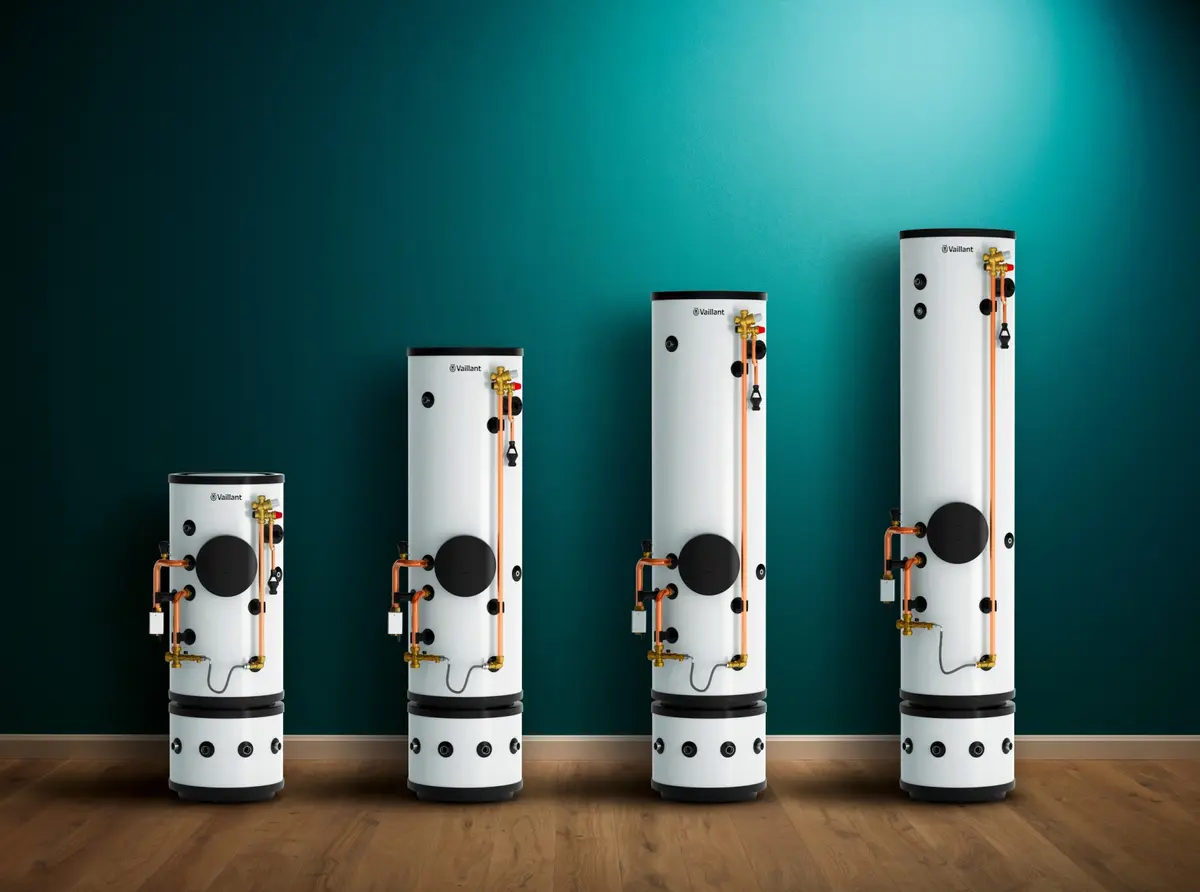
Why does the cylinder affect heat pump efficiency?
The water inside a cylinder's coil, which connects to the heat pump, and the domestic hot water you use at the tap are kept separate. Heat has to transfer from one side of the coil to the other. To drive that heat transfer, the heat pump needs to run at a higher temperature than the store. This temperature gap is called distortion.
The smaller the distortion, the lower the flow temperature the heat pump needs to run at. The lower the flow temperature, the higher the efficiency. Two things reduce distortion: a larger heat exchanger coil, where more surface area means heat transfers more easily at lower temperature differences; and good stratification, where colder water sits at the bottom of the cylinder near the coil so the heat pump is always exchanging heat against the coolest water available.
What size cylinder do you need?
Unlike with a combi boiler, you cannot size a cylinder too small and expect the heat pump to compensate. If the cylinder is undersized, the heat pump will need to reheat it more frequently and at higher temperatures. Heat pumps store water at a lower temperature than boilers, typically 48 to 55 degrees rather than 60 to 65 degrees, so you need a greater volume to have the same usable hot water available.
Usable hot water
Cylinders store water at 48 to 50 degrees. At the tap, that water is mixed with cold mains water to reach a comfortable 40 degrees. Because of that mixing, your actual usable hot water at 40 degrees is roughly 20 to 25% more than the stored volume. A 200 L cylinder storing water at 48 degrees gives you approximately 225 L of usable water at 40 degrees, enough for two or three ten-minute showers or one full bath with water left over.
Reheat time
Reheat time depends on the heat pump output and the cylinder size. A 9 kW heat pump can reheat a 200 L cylinder from cold to 48 degrees in approximately 50 minutes. If hot water demand is high or the cylinder is larger, plan for longer reheat windows, typically overnight or during cheap-rate tariff periods.
Types of cylinder
Unvented cylinders
The standard choice for modern heat pump installations. Water is stored under mains pressure, which delivers strong flow rates at taps and showers without needing a cold water tank in the loft. These are what we fit in the vast majority of homes.
Vented cylinders
Used in older systems with a cold water header tank in the loft. Flow pressure is lower. If a home already has a functioning vented cylinder in good condition, it may be possible to keep it. But most heat pump installations involve a new unvented cylinder.
Buffer tanks and volumisers
These are separate from the hot water cylinder. A buffer tank holds extra water in the heating circuit and helps the heat pump run in longer, more efficient cycles rather than short on/off bursts. Whether a buffer is needed depends on the system design. It is not always required and should not be added by default.
The cylinders we install
Heat Geek Super Cylinder
The Super Cylinder is designed by Heat Geek and manufactured by Newark Cylinders. It is built to maximise heat pump efficiency: a large heat exchanger coil at 6.0 m² on the main range, a 35 mm diffuser tube on the cold inlet to slow incoming water and preserve stratification, and tall slim construction to keep the thermocline intact.
The Super Cylinder is independently monitored at Heat Pump Monitor. Homes using a Super Cylinder with a well-commissioned heat pump consistently achieve hot water COP in the 400 to 550% range. Available from 150 L to 500 L, with a B-range from 200 L to 300 L for installations with restricted ceiling height.
Joule Cylinders
Joule is an Irish manufacturer with a strong reputation in the UK heat pump market. Their Pinnacle and Cyclone ranges are well-regarded by installers and are regularly specified on Heat Geek installations. Joule cylinders are unvented, stainless steel, and available in a range of sizes. A reliable choice where the Super Cylinder is not the right fit for a particular installation.
Heat Geek Mini Store
The Mini Store is a compact hot water solution designed for properties where space is severely constrained and a standard cylinder will not fit. It uses a shell and tube heat exchanger design which is more space-efficient than a coil. It is not a replacement for a full-size cylinder where space allows. A larger cylinder will always give better efficiency. But where space genuinely rules out the alternatives, the Mini Store is a practical option.
How cylinder design interacts with controls
Cylinder design is only half the story. How the cylinder is controlled makes an equally large difference. Store temperature should be set as low as practical, typically 48 degrees. Running at 55 degrees or above is only needed if the cylinder is undersized or hot water demand is unusually high. Anti-legionella cycles should happen on a schedule rather than daily, and a larger cylinder gives more scope to pre-heat water during cheap overnight tariff periods and avoid running the heat pump during expensive peak hours.
The cylinder is not an afterthought in a heat pump system. If you are planning an installation, make sure cylinder choice is part of the design conversation from the start, not a decision made at the end.
Cylinder sizing guide
These figures are larger than the equivalent cylinder for a gas boiler. Heat pumps store water at lower temperatures, so you need a greater volume to have the same usable hot water available.
| Bedrooms | Bathrooms | Recommended cylinder |
|---|---|---|
| 1 | 1 | 180 L |
| 2 | 1 | 180 L |
| 3 | 1 | 180 L |
| 3 | 2 | 210 L |
| 4 | 2 | 250 L |
| 5 | 2 | 300 L |
| 6 | 3 | 300 to 400 L |